Recipients

Full List

Living Recips

Most Recent

Recently
Departed

Contact
Recips

Community
Programs

Featured Recip

The Medal

Gallery

Community

The Society

Donations

Members Area


Full Citations of Living Recipients S
The stories of why the medal was awarded

Jump to other Citation Pages:

SAKATO, GEORGE T.

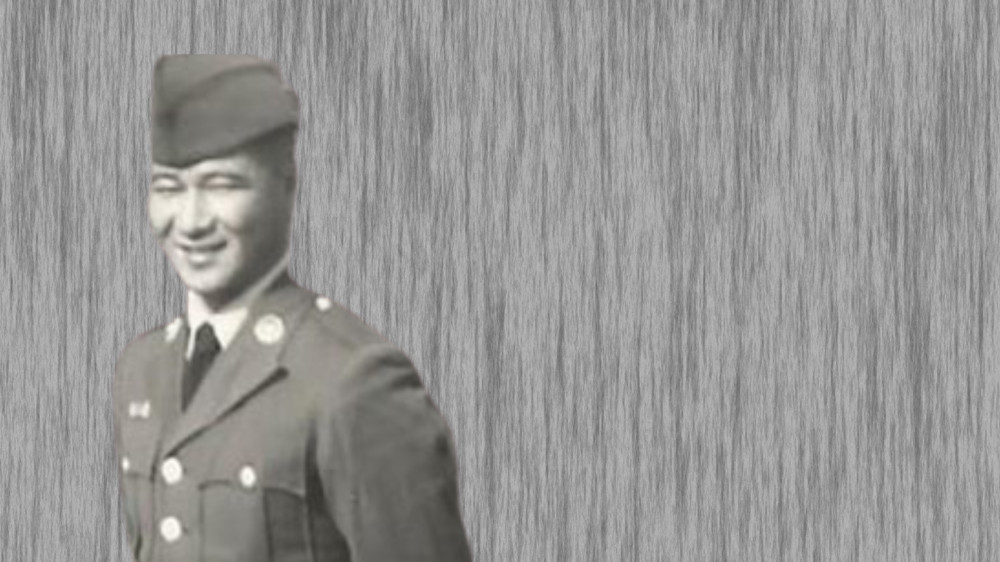
Private George T. Sakato distinguished himself by extraordinary heroism in action on 29 October 1944, on hill 617 in the vicinity of Biffontaine, France.  After his platoon had virtually destroyed two enemy defense lines, during which he personally killed five enemy soldiers and captured four, his unit was pinned down by heavy enemy fire.  Disregarding this fire, Private Sakato made a one-man rush that encouraged his platoon to charge and destroy the enemy strongpoint.  He proved to be the inspiration of his squad in halting a counter-attack on the left flank during the reorganization of his platoon.  It was at this time that his squad leader was killed.  Taking charge of the squad, he continued his relentless tactics.  Private Sakato used an enemy rifle and P-38 pistol to stop an organized enemy attack.  During this entire action, he killed 12 and wounded two, personally captured four and assisted his platoon in taking 34 prisoners.  By continuously ignoring the enemy fire and by his gallant courage and fighting spirit, he turned impending defeat into victory and helped his platoon complete its mission.  Private Sakato’s extraordinary heroism and devotion to duty are in keeping with the highest traditions of military service and reflect great credit on him, his unit, and the United States Army.

SASSER, CLARENCE EUGENE

Rank and organization: Specialist Fifth Class (then Pfc.), U.S. Army, Headquarters Company, 3d Battalion, 60th Infantry, 9th Infantry Division. Place and date: Ding Tuong Province, Republic of Vietnam, 10 January 1968. Entered service at: Houston, Tex. Born: 12 September 1947, Chenango, Tex. Citation: For conspicuous gallantry and intrepidity in action at the risk of his life above and beyond the call of duty. Sp5c. Sasser distinguished himself while assigned to Headquarters and Headquarters Company, 3d Battalion. He was serving as a medical aidman with Company A, 3d Battalion, on a reconnaissance in force operation. His company was making an air assault when suddenly it was taken under heavy small arms, recoilless rifle, machinegun and rocket fire from well fortified enemy positions on 3 sides of the landing zone. During the first few minutes, over 30 casualties were sustained. Without hesitation, Sp5c. Sasser ran across an open rice paddy through a hail of fire to assist the wounded. After helping 1 man to safety, was painfully wounded in the left shoulder by fragments of an exploding rocket. Refusing medical attention, he ran through a barrage of rocket and automatic weapons fire to aid casualties of the initial attack and, after giving them urgently needed treatment, continued to search for other wounded. Despite 2 additional wounds immobilizing his legs, he dragged himself through the mud toward another soldier 100 meters away. Although in agonizing pain and faint from loss of blood, Sp5c. Sasser reached the man, treated him, and proceeded on to encourage another group of soldiers to crawl 200 meters to relative safety. There he attended their wounds for 5 hours until they were evacuated. Sp5c. Sasser's extraordinary heroism is in keeping with the highest traditions of the military service and reflects great credit upon himself, his unit, and the U.S. Army.

SIMANEK, ROBERT E .

Rank and organization: Private First Class, U.S. Marine Corps, Company F, 2d Battalion, 5th Marines, 1st Marine Division (Rein.). Place and date: Korea, 17 August 1952. Entered service at: Detroit, Mich. Born: 26 April 1930, Detroit, Mich. Citation: For conspicuous gallantry and intrepidity at the risk of his life above and beyond the call of duty while serving with Company F, in action against enemy aggressor forces. While accompanying a patrol en route to occupy a combat outpost forward of friendly lines, Pfc. Simanek exhibited a high degree of courage and a resolute spirit of self-sacrifice in protecting the lives of his fellow marines. With his unit ambushed by an intense concentration of enemy mortar and small-arms fire, and suffering heavy casualties, he was forced to seek cover with the remaining members of the patrol in a nearby trench line. Determined to save his comrades when a hostile grenade was hurled into their midst, he unhesitatingly threw himself on the deadly missile absorbing the shattering violence of the exploding charge in his body and shielding his fellow marines from serious injury or death. Gravely wounded as a result of his heroic action, Pfc. Simanek, by his daring initiative and great personal valor in the face of almost certain death, served to inspire all who observed him and upheld the highest traditions of the U.S. Naval Service.

SPRAYBERRY, JAMES M .

Rank and organization: Captain (then 1st Lt.), U.S. Army, Company D, 5th Battalion, 7th Cavalry , 1st Cavalry Division (Airmobile). Place and date: Republic of Vietnam, 25 April 1968. Entered service at: Montgomery, Ala. Born: 24 April 1947, LaGrange, Ga. Citation: For conspicuous gallantry and intrepidity in action at the risk of his life above and beyond the call of duty. Capt. Sprayberry, Armor, U.S. Army, distinguished himself by exceptional bravery while serving as executive officer of Company D. His company commander and a great number of the men were wounded and separated from the main body of the company. A daylight attempt to rescue them was driven back by the well entrenched enemy's heavy fire. Capt. Sprayberry then organized and led a volunteer night patrol to eliminate the intervening enemy bunkers and to relieve the surrounded element. The patrol soon began receiving enemy machinegun fire. Capt. Sprayberry quickly moved the men to protective cover and without regard for his own safety, crawled within close range of the bunker from which the fire was coming. He silenced the machinegun with a hand grenade. Identifying several l-man enemy positions nearby, Capt. Sprayberry immediately attacked them with the rest of his grenades. He crawled back for more grenades and when 2 grenades were thrown at his men from a position to the front, Capt. Sprayberry, without hesitation, again exposed himself and charged the enemy-held bunker killing its occupants with a grenade. Placing 2 men to cover his advance, he crawled forward and neutralized 3 more bunkers with grenades. Immediately thereafter, Capt. Sprayberry was surprised by an enemy soldier who charged from a concealed position. He killed the soldier with his pistol and with continuing disregard for the danger neutralized another enemy emplacement. Capt. Sprayberry then established radio contact with the isolated men, directing them toward his position. When the 2 elements made contact he organized his men into litter parties to evacuate the wounded. As the evacuation was nearing completion, he observed an enemy machinegun position which he silenced with a grenade. Capt. Sprayberry returned to the rescue party, established security, and moved to friendly lines with the wounded. This rescue operation, which lasted approximately 71/2 hours, saved the lives of many of his fellow soldiers. Capt. Sprayberry personally killed 12 enemy soldiers, eliminated 2 machineguns, and destroyed numerous enemy bunkers. Capt. Sprayberry's indomitable spirit and gallant action at great personal risk to his life are in keeping with the highest traditions of the military service and reflect great credit upon himself, his unit, and the U.S. Army.

STONE, JAMES L.

Rank and organization: First Lieutenant, U.S. Army, Company E 8th Cavalry Regiment, 1st Cavalry Division. Place and date: Near Sokkogae, Korea, 21 and 22 November 1951. Entered service at: Houston Tex. Born: 27 December 1922, Pine Bluff, Ark. G.O. No.: 82, 20 October 1953. Citation: 1st Lt. Stone, distinguished himself by conspicuous gallantry and indomitable courage above and beyond the call of duty in action against the enemy. When his platoon, holding a vital outpost position, was attacked by overwhelming Chinese forces, 1st Lt. Stone stood erect and exposed to the terrific enemy fire calmly directed his men in the defense. A defensive flame-thrower failing to function, he personally moved to its location, further exposing himself, and personally repaired the weapon. Throughout a second attack, 1st Lt. Stone; though painfully wounded, personally carried the only remaining light machine gun from place to place in the position in order to bring fire upon the Chinese advancing from 2 directions. Throughout he continued to encourage and direct his depleted platoon in its hopeless defense. Although again wounded, he continued the fight with his carbine, still exposing himself as an example to his men. When this final overwhelming assault swept over the platoon's position his voice could still be heard faintly urging his men to carry on, until he lost consciousness. Only because of this officer's driving spirit and heroic action was the platoon emboldened to make its brave but hopeless last ditch stand.

STUMPF, KENNETH E.

Rank and organization: Staff Sergeant (then Sp4c.), U.S. Army, Company C, 1st Battalion, 35th Infantry, 25th Infantry Division. Place and date: Near Duc Pho, Republic of Vietnam, 25 April 1967. Entered service at: Milwaukee, Wis. Born: 28 September 1944, Neenah, Wis. Citation: For conspicuous gallantry and intrepidity in action at the risk of his life above and beyond the call of duty. S/Sgt. Stumpf distinguished himself while serving as a squad leader of the 3d Platoon, Company C, on a search and destroy mission. As S/Sgt. Stumpf's company approached a village, it encountered a North Vietnamese rifle company occupying a well fortified bunker complex. During the initial contact, 3 men from his squad fell wounded in front of a hostile machinegun emplacement. The enemy's heavy volume of fire prevented the unit from moving to the aid of the injured men, but S/Sgt. Stumpf left his secure position in a deep trench and ran through the barrage of incoming rounds to reach his wounded comrades. He picked up 1 of the men and carried him back to the safety of the trench. Twice more S/Sgt. Stumpf dashed forward while the enemy turned automatic weapons and machineguns upon him, yet he managed to rescue the remaining 2 wounded squad members. He then organized his squad and led an assault against several enemy bunkers from which continuously heavy fire was being received He and his squad successfully eliminated 2 of the bunker positions, but one to the front of the advancing platoon remained a serious threat. Arming himself with extra hand grenades, S/Sgt. Stumpf ran over open ground, through a volley of fire directed at him by a determined enemy, toward the machinegun position. As he reached the bunker, he threw a hand grenade through the aperture. It was immediately returned by the occupants, forcing S/Sgt. Stumpf to take cover. Undaunted, he pulled the pins on 2 more grenades, held them for a few seconds after activation, then hurled them into the position, this time successfully destroying the emplacement. With the elimination of this key position, his unit was able to assault and overrun the enemy. S/Sgt. Stumpf's relentless spirit of aggressiveness, intrepidity, and ultimate concern for the lives of his men, are in the highest traditions of the military service and reflect great credit upon himself and the U.S. Army.

SWETT, JAMES ELMS

Rank and organization: First Lieutenant, U.S. Marine Corps Reserve, Marine Fighter Squadron 221, with Marine Aircraft Group 12, 1st Marine Aircraft Wing. Place and date: Solomon Islands area, 7 April 1943. Entered service at: California. Born: 15 June 1920, Seattle, Wash. Other Navy award: Distinguished Flying Cross with 1 Gold Star. Citation: For extraordinary heroism and personal valor above and beyond the call of duty, as division leader of Marine Fighting Squadron 221 with Marine Aircraft Group 12, 1st Marine Aircraft Wing, in action against enemy Japanese aerial forces in the Solomons Islands area, 7 April 1943. In a daring flight to intercept a wave of 150 Japanese planes, 1st Lt. Swett unhesitatingly hurled his 4-plane division into action against a formation of 15 enemy bombers and personally exploded 3 hostile planes in midair with accurate and deadly fire during his dive. Although separated from his division while clearing the heavy concentration of antiaircraft fire, he boldly attacked 6 enemy bombers, engaged the first 4 in turn and, unaided, shot down all in flames. Exhausting his ammunition as he closed the fifth Japanese bomber, he relentlessly drove his attack against terrific opposition which partially disabled his engine, shattered the windscreen and slashed his face. In spite of this, he brought his battered plane down with skillful precision in the water off Tulagi without further injury. The superb airmanship and tenacious fighting spirit which enabled 1st Lt. Swett to destroy 7 enemy bombers in a single flight were in keeping with the highest traditions of the U.S. Naval Service.


Jump to other Citation Pages:

Back to: CMOHS Homepage


Copyright © 2004 Congressional Medal of Honor Society. All rights reserved.
Information in this document is subject to change without notice.